Questions & answers
Curious about powered paragliding but wondering about safety, equipment or what it takes? You’re not alone.
What is powered paragliding?
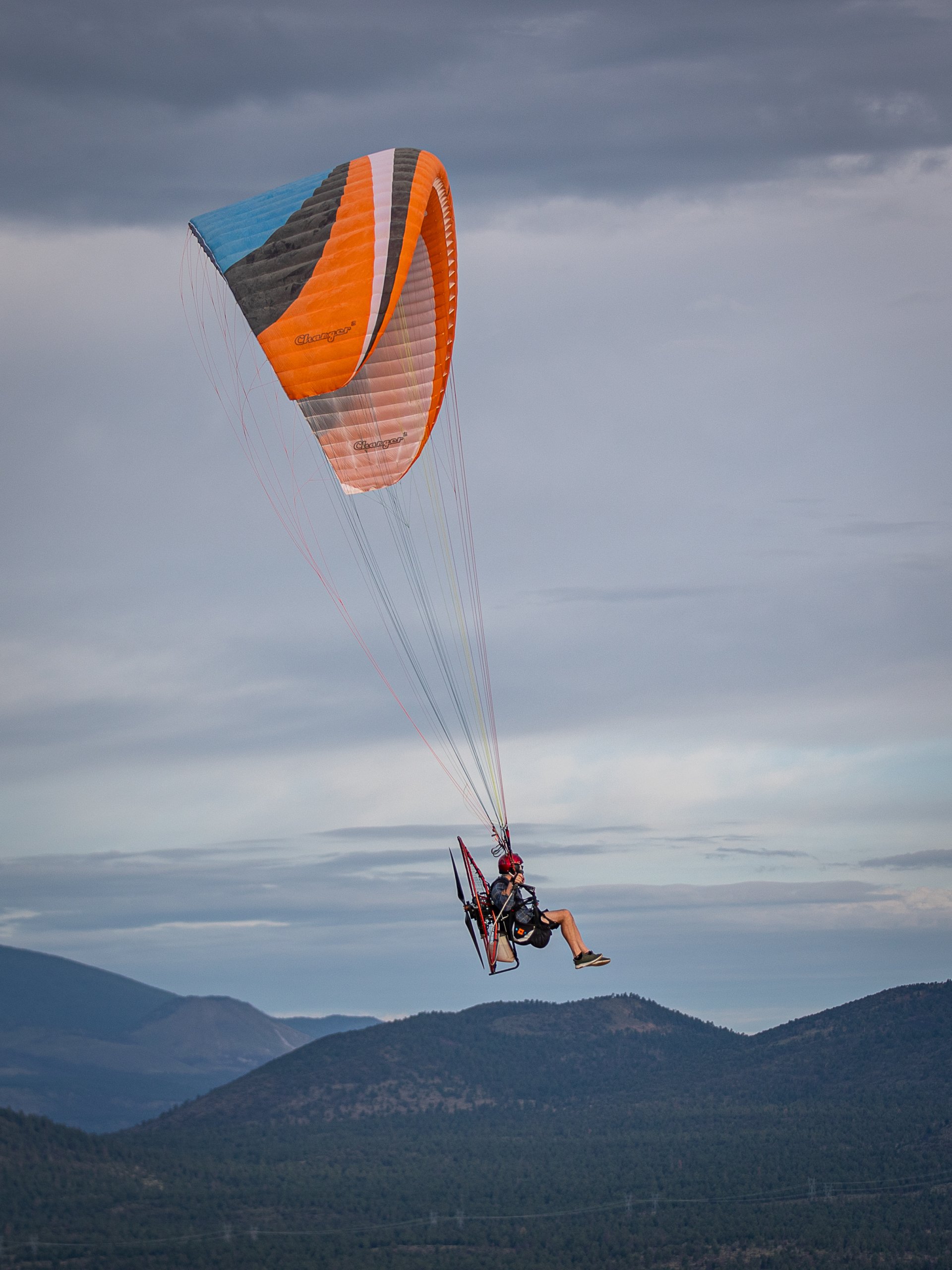
Powered paragliding, also called paramotoring or PPG, is one of the most accessible and exciting forms of ultralight aviation. The pilot wears a lightweight motor with a propeller and harness, called a paramotor, and flies beneath a paraglider wing. The motor provides enough thrust to take off on foot from level ground in calm air. No runway, no tow.
In the U.S. and many other countries it is lightly regulated and requires no pilot’s license. People love it for its simplicity: low running costs, little maintenance, easy to transport, and the freedom of flying low, slow and in the open air. Many airline and general-aviation pilots call it “the purest form of flight.”
Typical speeds are 15 to 50 mph, at anything from a few feet above the ground up to 18,000 feet (with the right clearances). Because the wing is soft and relatively slow, pilots avoid strong wind, turbulence and strong thermals, especially while learning.
A foot-launch paramotor weighs about 45 to 90 lb. After a short run of 10 to 50 feet the wing inflates and lifts pilot and motor into the air. Once airborne you sit in the harness and steer with brake toggles, using a hand throttle to climb and descend. Adding power doesn’t make you faster. It makes you climb.
Is it crazy or dangerous?
Statistically, powered paragliding is safer than riding a motorcycle. In our community we talk about risk versus reward: there is always some risk when your feet leave the ground, but the freedom and the thrill of real flight are worth it. Accidents do happen, almost always when pilots push their limits or skip basic safety practices.
Another thing we say: it’s as safe as you make it. Follow the rules, respect your limits, don’t fly like a YouTube stuntman, and you can enjoy decades of safe flying. We know pilots who have flown for more than 30 years without an incident.
Is paramotoring all it’s cracked up to be?
Without question, it’s one of the most thrilling and memorable things you’ll ever do. It’s just you, the sky and the hum of the motor. Almost every new pilot says the same thing after their first flight: “I wish I’d found this sooner.”
How do I know if PPG is for me?
Paramotoring isn’t for everyone, but almost anyone with the right attitude can learn. It takes coordination, focus and a real desire to learn. If you have decent hand-eye coordination, reasonable reflexes and can take coaching, you’re halfway there.
The sport rewards humility and persistence. Launching and landing take practice and some physical effort, so a bit of grit goes a long way.
It also takes time. Our beginner course is at least 16 hours of instruction and hands-on practice. Long gaps between sessions slow progress, so sessions on consecutive or closely spaced weekdays work best for building muscle memory and confidence.
I’m terrified of heights. Can I still do this?
Very likely. There are two different fears: acrophobia, the fear of being near an edge (a rooftop, a ladder, a cliff), and aerophobia, the fear of flying. Your mind treats them very differently. Plenty of people who hate balconies are perfectly calm in an airplane.
If you can fly commercially without panicking, there’s a good chance you’ll be fine in a paramotor. Your first solo may feel a little intimidating, and that’s normal, but once the wing lifts you, something clicks. Most new pilots describe a mental switch: “I’m safe, I’m flying.” From then on the fear turns into excitement.
How physically demanding is it?
Being reasonably fit helps, but you don’t need to be an athlete. If you can jog about 100 yards without stopping, you can probably foot launch. If you’re significantly overweight or have knee, hip or joint problems, a trike may suit you better. There’s no running on takeoff or landing, which is easier on the body and often safer.
How long does it take to learn?
It depends on your coordination, how quickly you pick things up, and how much time you can commit. Some students are flying confidently in four days, others take closer to ten, and a few need more. Everyone learns at their own pace.
If you need to pause and come back later, we pick up where you left off, though you may need a refresher first. And the learning never really stops: every flight teaches you something.
What happens if the motor quits in flight?
Nothing dramatic. You glide down. Your wing is always overhead and flying, motor or not. If the engine stops, you pick a landing spot, set up your approach with a few gentle S-turns and land, just as you would at the end of any flight.
Real engine failures are uncommon when equipment is maintained. The most common cause of a motor-out is neglect, not bad luck. Treat your paramotor like an aircraft: inspect it regularly and stay ahead of maintenance. We cover all of this in training.
Do I need a license or registration?
In the U.S., no license or certificate is currently required. Paramotors fall under FAR Part 103, which covers ultralight aircraft. As long as the machine stays within the weight and fuel limits (under 5 gallons), no pilot license, registration or medical is needed.
Can you buy a paramotor and teach yourself? Technically. Should you? Absolutely not. Many people have learned the hard way that this sport demands real skill and knowledge. Proper training teaches you how to launch safely, handle emergencies and make good decisions in the air.
The one thing that does require FAA approval is flying a passenger, which needs a tandem exemption. Paid passenger rides aren’t allowed, though sharing costs such as fuel is.
Where can I fly?
Almost anywhere with open space that isn’t controlled or restricted airspace. Paramotors usually fly in Class G and E airspace, which covers most of the country. Stay clear of Military Operations Areas and restricted zones. In training we teach you how to read airspace charts and plan legal flights, and you’ll be surprised how much sky is open to you, especially here in Arizona.
Can I carry passengers?
Not without an FAA tandem exemption. To get one you first earn an instructor rating through an organization that holds that authorization, such as ASC or USPPA. Our tandem flights are flown under our ASC-issued exemption, which lets certified instructors fly with students for training.
Want to fly tandem yourself someday? Once you have a few years of flying experience, we can train you to become a tandem pilot and help you work toward your tandem instructor rating.
What kind of motor and fuel do paramotors use?
Most use lightweight two-stroke engines built for flight, with a great balance of power and weight for foot launching. Some pilots choose four-strokes, which are smoother and more efficient but heavier, so they’re usually found on trikes and quads.
Two-strokes run on gas mixed with oil, typically between 32:1 and 66:1 depending on the manufacturer. Mixing quickly becomes second nature. Most pilots, including us, run 91-octane pump gas. Some prefer ethanol-free fuel; others like a detergent gas such as Chevron with Techron to keep the engine clean and cool.
Are paramotors loud?
Yes. Some engines reach around 150 decibels. That’s why pilots wear helmets with ear cups, which cut noise by roughly 30 decibels, and many add earplugs underneath. With both, the noise is very manageable.
Do I need my own gear for training?
Yes. You train on your own paramotor and wing (see why we don’t rent below). Your equipment ships to us, and your instructor helps you assemble and set it up properly before you fly. During training, every student uses our helmets and radio communication equipment, whatever other gear they bring. Talk to us before you buy anything, because some paramotor gear can get you hurt. If you bring your own equipment, we’ll inspect it before your first flight to make sure it’s airworthy, and if it’s pre-owned we’ll ask how long you’ve had it and roughly how many hours it has.
Why don’t you rent training gear?
Because you’ll learn faster and fly safer on the equipment you’re going to own. Every paramotor and wing behaves a little differently: the throttle, the hang point and how the frame sits on your back, how the wing inflates, how hard it pulls and how it answers the brakes.
Students who learn on a school’s machine and then switch to their own often find it feels unfamiliar, even when the two look alike. That leaves them relearning muscle memory at the worst possible time, sometimes right at launch. Training on your own gear from day one avoids that: the setup, the feel and the habits you build carry straight over to every flight afterward.
A word of warning: you may read online that you should avoid schools that don’t provide rental gear. That advice gets it backwards. A school’s rental gear is equipment you’ll fly for a few days and then hand back, and the switch to your own machine is exactly where unfamiliarity and uncomfortable surprises creep in. Learning on the gear you’ll actually fly is the safer path.
Are you still around after my training?
Absolutely. Training is a process, not an event. Your formal instruction is the first few days, but we’re here for advice, mentoring and guidance as your skills grow. And we simply love to fly. You’ll often find us in the field, happy to fly with our students. Once you train with us, you’re part of the Arizona Paramotor community.
Do you sell paramotors and wings?
Yes. We’re authorized dealers for several leading paramotor and wing brands, and we’ll help you find what fits your flying, experience and budget. See our gear page for the brands we carry and our favorites. We’ll never pressure you toward a particular model. We’ll just share what we’ve flown, tested and seen in the field, as much or as little as you want.
Are prices negotiable?
Equipment prices are set by the manufacturers and are the same at every authorized dealer. No one sells below MSRP. Where we can add value is training: we sometimes offer incentives when you buy your equipment through us. And when you do, you get our full support with setup, safety and instruction.
Do you offer refunds?
Training spots and equipment allocations are limited, so payments are final once your course or order is scheduled. We understand that life happens: you can reschedule training without penalty with at least 14 days’ notice. Inside 14 days, a rescheduling fee or loss of deposit may apply depending on the circumstances.
Refunds aren’t guaranteed and are considered case by case at Arizona Paramotor’s discretion, and may be subject to a processing fee. If we cancel or postpone a class because of weather or instructor availability, you can reschedule at no cost. By enrolling in training or buying equipment, you agree to these terms.